

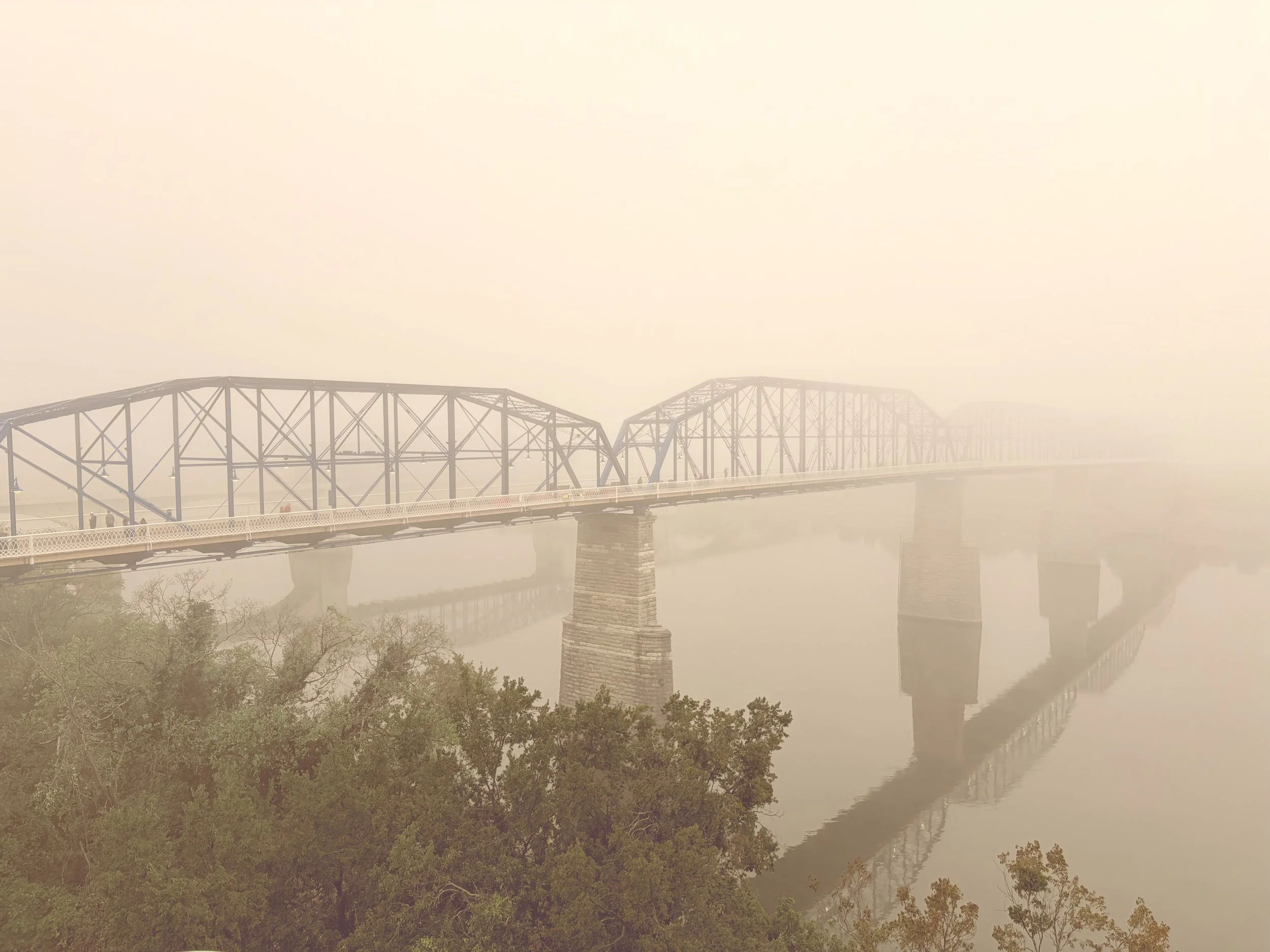
The Bridge Chattanooga Refused to Lose
How historic preservation helped transform a city - and created a lasting legacy
Today, the Walnut Street Bridge is one of Chattanooga's most recognizable landmarks. Its distinctive blue steel trusses stretch across the Tennessee River, connecting downtown with the North Shore and welcoming thousands of pedestrians each year. But the bridge's future was once anything but certain.
In fact, one of Chattanooga's most celebrated public spaces came remarkably close to disappearing.
Built in 1891, the Walnut Street Bridge was an engineering achievement of its time, providing a vital transportation connection between downtown Chattanooga and communities north of the Tennessee River. For nearly nine decades, it carried horse-drawn vehicles, automobiles, and pedestrians across the river, helping shape the city's growth.
By the 1970s, however, the aging structure had deteriorated. In 1978, the bridge was closed to automobile traffic, and demolition increasingly appeared to be its likely fate.
What happened next would become one of Chattanooga's greatest preservation success stories.
A Different Vision for an Old Bridge
During the 1980s, community leaders, preservation advocates, and public officials began exploring an alternative to demolition. Rather than viewing the bridge as obsolete infrastructure, they envisioned something entirely different: a pedestrian connection that could become a public gathering place and help reconnect Chattanooga with its riverfront.
Among those involved was Landmarks Chattanooga, the predecessor of Cornerstones and today's Preserve Chattanooga. Working alongside Chattanooga Venture and other community partners, preservation advocates helped demonstrate that the historic bridge could have a meaningful future.
The effort was not without challenges. Rehabilitation would require substantial engineering work and significant financial investment. But advocates recognized something that has since become a guiding principle of historic preservation: a building or structure can outlive its original purpose without outliving its usefulness.
Public enthusiasm proved equally important. During the 1987 Riverbend Festival, a community straw poll found that an overwhelming 94 percent of respondents supported restoring the bridge.
The public had spoken. Chattanooga wanted its bridge.
Turning Preservation into Possibility
Saving the Walnut Street Bridge required more than enthusiasm. It demanded creative financing, innovative engineering, and cooperation among local, state, and federal partners.
Federal funding originally associated with the bridge's removal was redirected toward rehabilitation, while a community fundraising campaign helped generate additional financial support. Engineers developed approaches that made restoration more affordable, and hundreds of volunteers participated in the effort.
The project also demonstrated the importance of federal historic preservation protections. Through the Section 106 review process established by the National Historic Preservation Act, alternatives to demolition received consideration, helping create an opportunity for the bridge's preservation.
In 1990, the Walnut Street Bridge was listed in the National Register of Historic Places. Three years later, following an approximately $4.5 million rehabilitation, it reopened as a pedestrian bridge.
What had once been considered an aging liability had become an extraordinary civic asset.
A Bridge That Helped Transform Chattanooga
The reopening in 1993 coincided with a remarkable period of change in Chattanooga.
The Tennessee Aquarium had opened the previous year, and new investments were beginning to reshape the downtown riverfront. The Walnut Street Bridge provided something essential to that transformation: a walkable connection between downtown and the North Shore.
Its preservation helped encourage reinvestment in surrounding neighborhoods, supported local businesses, and created a public space that became part of Chattanooga's identity.
The bridge was no longer simply a way to cross the river. It had become a destination in its own right.
In 2013, the American Planning Association recognized the Walnut Street Bridge as one of America's Great Public Spaces, acknowledging its role in Chattanooga's revitalization.
A Lasting Connection to Preserve Chattanooga
The bridge's preservation also helped create another Chattanooga tradition.
In 1994, Cornerstones launched Wine Over Water, bringing wine, food, and music to the historic bridge while raising funds to protect other important places throughout the community.
The event grew into one of Chattanooga's signature celebrations and an important source of support for local preservation efforts.
It was a fitting continuation of the bridge's story: a historic structure saved through community investment was now helping generate resources to preserve Chattanooga's architectural heritage.
Preserving More Than Steel and Timber
The Walnut Street Bridge also carries a difficult history that deserves acknowledgment.
In 1893, Alfred Blount was lynched from the bridge, followed in 1906 by Ed Johnson, whose murder occurred despite a stay of execution from the United States Supreme Court. Johnson's case led to the landmark United States v. Shipp proceedings, an important chapter in American constitutional and civil rights history.
Preserving historic places means recognizing their complete stories, including painful chapters. The bridge is both a symbol of Chattanooga's civic progress and a reminder of the injustices that are part of our shared history.
A New Chapter for a Historic Landmark
In October 2026, the Walnut Street Bridge reopened following another major rehabilitation, ensuring that this remarkable landmark can continue serving Chattanooga for generations to come.
More than three decades after its first transformation, the bridge remains a powerful demonstration of what historic preservation can accomplish.
Its story reminds us that preservation is not simply about protecting old buildings and structures. It is about recognizing their potential, finding new purposes for historic places, and making investments that strengthen communities.
The people who fought to save the Walnut Street Bridge in the 1980s could not have fully anticipated the role it would play in Chattanooga's revitalization. They understood, however, that losing the bridge would mean losing something irreplaceable.
Today, every person who walks across the Walnut Street Bridge benefits from that decision.
For Preserve Chattanooga, the lesson remains as relevant as ever: the places we choose to preserve today can become the landmarks, gathering places, and economic engines of tomorrow.
The future of Chattanooga's past is in our hands.